Quick comparison
The essential facts side by side. Figures that change each year name their class or year; this independent guide is not affiliated with either academy.
| Category | Naval Academy | West Point |
|---|---|---|
| Official name | United States Naval Academy | United States Military Academy |
| Abbreviation | USNA | USMA |
| Founded | Oct. 10, 1845 | March 16, 1802 |
| Location | Annapolis, Maryland | West Point, New York |
| Primary service | Navy and Marine Corps | Army |
| Students called | Midshipmen | Cadets |
| Student body | Brigade of Midshipmen | Corps of Cadets |
| Degree | Bachelor of Science | Bachelor of Science |
| Mascot | Bill the Goat | Army Mules |
| Motto | Ex Scientia Tridens (From Knowledge, Sea Power) | Duty, Honor, Country |
| Athletic nickname | Midshipmen | Black Knights |
| Program length | Four years | Four years |
| Tuition | None; federally funded | None; federally funded |
| Commissioning | Navy ensign or Marine Corps second lieutenant | Army second lieutenant |
| First Army-Navy Game | 1890 (won 24-0) | 1890 (lost 24-0) |
| Enrollment | About 4,400 (2025-26 fact sheet) | About 4,400 (academy figure, 2026) |
| Graduating class | 1,059 (Class of 2026) | Nearly 1,000 (Class of 2026) |
| Applications | 16,814 (Class of 2030) | More than 13,600 (Class of 2030) |
| Offers of appointment | 1,471 (Class of 2030) | Not published |
| Admission rate | 8.7% (offers divided by applications, Class of 2030) | Not calculable from published figures |
| Entering class | 1,194 (Class of 2030 portrait) | More than 1,230 U.S. cadets plus about 20 international (Class of 2030, announced at R-Day) |
| Academic majors | 23 for current classes (2025-26) | 36 (academy figure) |
| Student-faculty ratio | 8 to 1 (2025-26) | 7 to 1 (academy figure) |
| Campus size | 338 acres, the Yard | Military reservation of more than 16,000 acres |
| Football conference | American Athletic Conference (since 2015) | American Athletic Conference (since 2024) |
| Summer military training | Plebe Summer, then fleet, aviation and Marine training each summer | Cadet Basic Training, then field and Army-unit training each summer |
| Standard active-duty obligation | At least five years | Five years, plus three in the reserves |
History: Which academy is older?
Annapolis: A Navy school founded ashore
For its first decades the Navy trained officers the old way: teenagers went to sea as midshipmen and learned aboard ship, with only scattered schooling ashore. Navy Secretary George Bancroft changed that in 1845, opening the Naval School on Oct. 10 at the Army's old Fort Severn (opens in a new tab) in Annapolis, Maryland, with about 50 midshipmen and seven professors.
The school became the U.S. Naval Academy in 1850 and adopted a four-year course with summer practice cruises. During the Civil War it moved to Newport, Rhode Island, returning to Annapolis in 1865. As steam, steel and electricity transformed warships, the curriculum shifted toward engineering, and the academy grew into the source of officers for both the Navy and the Marine Corps.
West Point: The older academy
West Point was a fortress before it was a school. The Continental Army occupied the bluffs above a sharp S-curve in the Hudson River in 1778, because whoever held the river could split New England from the other colonies. George Washington chose Polish engineer Thaddeus Kosciuszko to design the defenses, and soldiers stretched the Great Chain across the river that spring. In 1780 Benedict Arnold, the post's commander, plotted to hand it to the British; the scheme collapsed with the capture of Maj. John André, and West Point was never taken.
Thomas Jefferson signed the law creating the U.S. Military Academy (opens in a new tab) on March 16, 1802. Its early purpose was technical: train engineers and artillerists so the young country would not depend on foreign experts. Sylvanus Thayer, superintendent from 1817 to 1833, built the rigorous four-year curriculum, small graded sections and engineering focus that made West Point the nation's first engineering school. Graduates built roads, canals and railroads, and they led Army forces in every war that followed — on both sides of the Civil War.
West Point is 43 years older, and the difference shows in each academy's character. West Point began as a national school of engineering in a Revolutionary War fortress, so its identity is tied to the founding of the country and to the Army's land campaigns. Annapolis was created to professionalize a sea service that had trained officers aboard ship, so its identity centers on seamanship, naval engineering and, later, aviation and nuclear propulsion. Both academies excluded Black Americans and women for long periods and admitted them only after hard-fought change.
Side-by-side timeline, 1778-2026
- 1778
West Point: The Continental Army fortifies West Point and stretches the Great Chain across the Hudson.
- 1780
West Point: Benedict Arnold's plot to surrender West Point fails.
- 1802
West Point: Thomas Jefferson signs the law establishing the U.S. Military Academy on March 16.
- 1817
West Point: Sylvanus Thayer becomes superintendent and begins his reforms.
- 1835
West Point: West Point's Class of 1835 introduces the class ring.
Naval Academy: The Naval School opens Oct. 10 at Fort Severn in Annapolis.
1845Naval Academy: The school is renamed the U.S. Naval Academy.
1850Naval Academy: The academy relocates to Newport, R.I., during the Civil War.
1861-65West Point: Graduates command armies on both sides of the Civil War.
- 1877
West Point: Henry O. Flipper becomes West Point's first Black graduate.
Naval Academy: Navy plays its first football game, Dec. 11.
1879- 1890
Both academies: Navy beats Army 24-0 at West Point on Nov. 29 in the first Army-Navy Game.
Naval Academy: A goat first appears as Navy's mascot.
1893- 1899
West Point: A mule first appears as Army's mascot.
Naval Academy: Navy goes 9-0-1 and claims a share of the national championship.
1926- 1944-46
West Point: Army wins three straight national championships; Doc Blanchard and Glenn Davis win Heisman Trophies.
Naval Academy: Wesley A. Brown becomes the Naval Academy's first Black graduate.
1949- 1958
West Point: Pete Dawkins wins Army's third Heisman Trophy.
Naval Academy: Navy-Marine Corps Memorial Stadium opens Sept. 26.
1959Naval Academy: Joe Bellino and Roger Staubach win Heisman Trophies.
1960 & 1963- 1976
Both academies: Both academies admit their first women, following a 1975 act of Congress.
- 1980
Both academies: The first classes including women graduate from both academies.
Naval Academy: Navy wins 14 straight Army-Navy Games, the longest streak in the series.
2002-15Naval Academy: Navy football joins the American Athletic Conference.
2015- 2024
West Point: Army football joins the American Athletic Conference and wins its title in its first season.
Naval Academy: The Class of 2030 reports on Induction Day, June 25.
2026West Point: The Class of 2030 reports on R-Day, June 29.
The full chronologies are in the Naval Academy timeline and the West Point timeline.
Admissions: Which is harder to get into?
The two application processes are nearly identical, because federal law sets most of the rules for every service academy. Candidates must be U.S. citizens, unmarried, without children or other dependents, and at least 17 but not yet 23 on July 1 of the year they enter. Each academy then requires a nomination, a qualifying medical exam, a physical fitness test and a competitive academic record.
Requirements and process
| Category | Naval Academy | West Point |
|---|---|---|
| Academic preparation | Strong college-preparatory record with emphasis on math, science and English; current classes earn a Bachelor of Science regardless of major. | Strong college-preparatory record; the curriculum is weighted toward math, science and engineering for every cadet. |
| Standardized tests | Test-required. The Class of 2030 required the SAT or ACT; Class of 2031 instructions accept the SAT, ACT or CLT, taken before Feb. 1, 2027. | Test-required. The current admissions site accepts the SAT, ACT or CLT and superscores; official scores are due Jan. 31 of senior year. |
| Nomination | From a U.S. representative or senator, the vice president, or service-connected categories such as presidential, enlisted Navy and Marine Corps, ROTC and children of Medal of Honor recipients. | From a U.S. representative or senator, the vice president, or service-connected categories such as presidential, Regular Army and reserve-component enlisted, ROTC and children of Medal of Honor recipients. |
| Candidate Fitness Assessment | Six events in under 40 minutes: kneeling basketball throw, pull-ups or flexed-arm hang, shuttle run, crunches, push-ups and a one-mile run. | Six events: basketball throw, pull-ups or flexed-arm hang, 40-yard shuttle run, modified sit-ups, push-ups and a one-mile run. |
| Medical exam | Reviewed by the Department of Defense Medical Examination Review Board (DoDMERB); the academy decides any waiver. | Scheduled through DoDMERB after the initial application review. |
| Application deadline | Jan. 31 of senior year; most decisions by April 15. | Jan. 31 of senior year for the candidate checklist; the application opens Feb. 15 of junior year. |
| Summer program for juniors | Summer Seminar: six days; the application doubles as the preliminary application ($575 fee for 2027). | Summer Leaders Experience: five days for rising seniors (2027 sessions May 29 through June 14); no obligation to attend. |
| Preparatory school | Naval Academy Preparatory School, Newport, R.I., 10 months. The Class of 2030 included 190 NAPS graduates and 49 Foundation or civilian-prep entrants. | U.S. Military Academy Preparatory School, a 10-month program that begins with cadet candidate basic training. |
Class of 2030 admissions figures
| Category | Naval Academy | West Point |
|---|---|---|
| Applications | 16,814 | More than 13,600 |
| Offers of appointment | 1,471 | Not published |
| Entering students | 1,194 | More than 1,230 U.S. cadets plus about 20 international |
| Admission rate (offers divided by applications) | 8.7% | Not calculable from published figures |
Acceptance rates alone do not show which academy is harder to enter. Each academy counts "applicants" differently, many candidates apply to both, and the decisive steps — a nomination, a medical qualification and a passing fitness test — screen out large numbers of people before any admission decision. West Point did not publish a Class of 2030 offer count, so no comparable rate can be calculated for it. Both are among the most selective colleges in the country, and a qualified candidate's real challenge is usually earning a nomination.
How to decide which academy to apply to
- You want to lead soldiers on land
- West Point commissions every graduate into the Army, from infantry and armor to aviation, cyber and logistics.
- You are drawn to ships, submarines or the sea
- Only the Naval Academy leads to surface warfare and submarine service; it is also the academy with a dedicated naval architecture major.
- You want to be a Marine officer
- Annapolis is the only service academy that commissions large numbers of Marine Corps officers — 267 in the Class of 2026.
- You want to fly
- Both lead to aviation: Navy and Marine pilots and naval flight officers from Annapolis, Army helicopter pilots from West Point. Aviation adds years of service at both.
- Engineering or technology is your priority
- Both offer aerospace, mechanical, electrical, nuclear and computer science majors. Annapolis adds naval architecture and ocean engineering; West Point adds civil, chemical and environmental engineering.
- You prefer the humanities or social sciences
- West Point offers a wider list, including philosophy, law, psychology and language majors. Annapolis offers history, English, political science and economics.
Academics: West Point vs. Naval Academy
Both academies award only the Bachelor of Science, even to history and English majors, because every student completes a heavy core in mathematics, science and engineering. West Point's Class of 2030 catalog (opens in a new tab) lists 24 common-core courses plus a three-course engineering sequence; the Naval Academy's core adds subjects tied to naval service, such as propulsion, weapons and control systems, and navigation. Students at both pick a major near the end of their first year.
The differences follow the services. Annapolis builds its technical offerings around ships, submarines and aircraft — naval architecture, ocean engineering, oceanography and nuclear engineering for the Navy's reactor program. West Point's list is broader in the social sciences and humanities, reflecting the Army's need for officers who understand terrain, populations, law and foreign cultures; it offers majors in eight foreign languages, while the Naval Academy now offers languages as minors.
Both are accredited by the Middle States Commission on Higher Education, and both have ABET-accredited engineering and computing programs, though not every major is ABET-accredited. The Naval Academy reports nearly 600 faculty, roughly half military and half civilian. West Point's faculty is majority military officers; it has not published a current percentage.
Majors compared
Program titles as listed by each academy. "No equivalent" means no major in that field appears in the academy's current list.
| Discipline | Naval Academy | West Point |
|---|---|---|
| Aerospace engineering | Aerospace Engineering | Aerospace Engineering |
| Mechanical engineering | Mechanical Engineering | Mechanical Engineering |
| Electrical engineering | Electrical Engineering | Electrical Engineering |
| Nuclear engineering | Nuclear Engineering | Nuclear Engineering |
| Computer science | Computer Science | Computer Science |
| Cybersecurity | Cyber Operations | Cyber Science |
| Computer engineering | Computer Engineering | No separate major |
| Robotics and systems | Robotics and Control Engineering | Systems Engineering |
| Naval architecture | Naval Architecture and Marine Engineering | No equivalent |
| Ocean engineering and oceanography | Ocean Engineering; Oceanography | No equivalent |
| Civil and environmental engineering | No equivalent | Civil Engineering; Environmental Engineering |
| Chemical engineering | No equivalent | Chemical Engineering |
| General engineering or science | General Engineering; General Science | Engineering Management |
| Mathematics | Mathematics | Mathematical Sciences |
| Data science | Data Science | Applied Statistics and Data Sciences |
| Operations research | Operations Research | Operations Research |
| Physics and chemistry | Physics; Chemistry | Physics; Chemistry |
| Biology | No equivalent | Biology |
| Economics | Quantitative Economics | Economics |
| Political science | Political Science | American Politics; International Affairs |
| History | History | History |
| English | English | English |
| Foreign area studies | Foreign Area Studies | Foreign Area Studies (six regions) |
| Foreign languages | Minors only (Arabic and Chinese majors end with the Class of 2027) | Majors in Arabic, Chinese, French, German, Persian, Portuguese, Russian and Spanish |
| Law | No equivalent | Law and Legal Studies |
| Psychology | No equivalent | Behavioral Science; Engineering Psychology |
| Philosophy | No equivalent | Philosophy |
| Geography | No equivalent | Geography; Geospatial Science |
| Management | No equivalent | Management |
| Kinesiology | No equivalent | Kinesiology |
Military training
Naval Academy
- Induction Day
- New plebes report in late June — June 25, 2026, for the Class of 2030 — trade civilian clothes for uniforms and take the oath of office.
- Plebe Summer
- About seven weeks of military drill, physical training, sailing, seamanship and naval customs before classes begin.
- Brigade of Midshipmen
- Midshipmen live in Bancroft Hall in 30 companies; upper-class midshipmen run the brigade's daily life under officer supervision.
- Sea Trials
- A demanding day of team physical and mental challenges in May that closes plebe year.
- Summer training
- Each summer brings fleet familiarization and leadership assignments, including training cruises aboard Navy ships.
- Professional Training of Midshipmen
- A four-week rotation introducing aviation, submarines, surface warfare and the Marine Corps.
- Marine Corps training
- Midshipmen seeking the Marine Corps complete the four-week Leatherneck program at Quantico, Va., before senior year.
- Physical readiness
- A physical readiness test every semester: push-ups, a plank and a 1.5-mile run.
- Service Selection
- In the fall of senior year midshipmen learn their warfare community; in the Class of 2026, 79% received their first choice.
West Point
- Reception Day
- New cadets report in late June — June 29, 2026, for the Class of 2030 — for haircuts, uniforms, medical checks and their first military instruction.
- Cadet Basic Training
- Known as Beast Barracks, it lasted six weeks in 2026 and ended with the March Back on Aug. 10.
- Corps of Cadets
- Cadets are organized into companies, battalions and regiments led by a cadet chain of command, with Army officers and noncommissioned officers as advisers.
- Cadet Field Training
- Rising sophomores train in field tactics at Camp Buckner on the academy's reservation.
- Cadet Leader Development Training
- A four-week tactical leadership exercise, usually before senior year.
- Cadet Troop Leader Training
- Upper-class cadets serve as acting platoon leaders in active Army units.
- Army schools
- Many cadets attend Army schools in summer; about 600 earned the Air Assault badge in 2026.
- Physical training
- Cadets take the Army Fitness Test, which replaced the Army Combat Fitness Test on June 1, 2025.
- Branch selection
- Talent-based branching matches cadets with Army branches; the Class of 2026 learned its branches in December 2025, and 72% received their first choice.
Four years, from entering student to officer
| Category | Naval Academy | West Point |
|---|---|---|
| First year | Plebe (fourth class): Plebe Summer, plebe indoctrination, core courses; ends with Sea Trials and the Herndon Monument climb. | Plebe (fourth class): Cadet Basic Training, core courses; plebes are formally recognized as members of the Corps during the year. |
| Second year | Youngster (third class): major coursework begins; summer at sea and professional training. | Yearling (third class): Cadet Field Training at Camp Buckner; major coursework begins. |
| Third year | Second class: formal commitment to service; leadership roles in the brigade; Marine candidates prepare for Leatherneck. | Cow (second class): Affirmation ceremony commits cadets to service; leadership roles in the Corps. |
| Fourth year | First class: Service Selection in the fall; Commissioning Week and the hat toss in May. | Firstie (first class): Ring Weekend, Branch Night, 100th Night and Post Night; graduation in May. |
| Commission | Ensign, U.S. Navy, or second lieutenant, U.S. Marine Corps. | Second lieutenant, U.S. Army. |
Student life and daily routines
| Category | Naval Academy | West Point |
|---|---|---|
| Morning | Plebes may rise as early as 5:30 a.m.; morning quarters formation at 7 a.m. | Mandatory family-style breakfast in Washington Hall, 6:55 to 7:30 a.m. |
| Meals | The whole brigade eats together in King Hall; noon meal formation on weekdays. | The Corps eats family-style at 12-person tables in Washington Hall. |
| Classes | Morning and afternoon classes, typically 10 to 22 students. | Morning classes from 7:35 a.m.; afternoon classes until 3:50 p.m. |
| Afternoons | Varsity, club or intramural athletics and military duties. | Athletics from 4:10 to 5:45 p.m.; every cadet competes in some sport. |
| Evenings | Study period; taps at 10 p.m. for plebes and 11 p.m. for upper classes on weeknights. | Study time after dinner; academic and military duties fill evenings. |
| Weekends | Liberty grows by class: fall plebes have Saturday afternoon and evening; seniors receive additional weekday privileges. | Passes grow by class; firsties have the most freedom, subject to standing and approval. |
| Housing | Every midshipman lives in Bancroft Hall. | Cadets live in barracks around the Plain. |
| Honor | Honor Concept: "Midshipmen are persons of integrity: They stand for that which is right." | Cadet Honor Code: "A cadet will not lie, cheat, steal, or tolerate those who do." |
| Religious life | Naval Academy Chapel, the Uriah P. Levy Center and Jewish Chapel, and other services. | Cadet Chapel, Catholic and Jewish chapels and other services. |
The honor codes differ in one important way: West Point's explicitly makes tolerating another cadet's violation an offense, while the Naval Academy's Honor Concept is written as a statement of values that midshipmen are expected to uphold.
A Day in the Life: West Point Cadet vs. Naval Academy Midshipman
Illustrative schedules. These outlines are drawn from each academy's published routines; actual days vary by class year, season, duties and athletic schedules.
Naval Academy midshipman
- Earliest rising for plebes
- Morning quarters formation
- Classes
- Noon meal formation (most weekdays)
- Noon meal in King Hall
- Classes, then athletics and military duties
- Evening meal and study period
- Taps for plebes (11 p.m. for upper classes)
West Point cadet
- Family-style breakfast in Washington Hall
- Morning classes begin
- Lunch in Washington Hall
- Afternoon classes
- Athletics
- Dinner
- Study time and duties
- Taps
Cost, pay and service obligations
Neither academy charges tuition, room or board (opens in a new tab). In exchange, graduates serve as officers. That bargain makes them unlike any civilian college: students are members of the armed forces from the day they report, they are paid a salary, and leaving after a certain point carries obligations.
Federal law sets pay for both cadets and midshipmen at 35% of an ensign's or second lieutenant's basic pay. In 2026 that was $1,452.90 a month before deductions. Much of it goes to required expenses: the Naval Academy advanced the Class of 2030 $12,500 for uniforms, a computer and other gear, repaid at $380 a month starting in October, and gave plebes a $250 monthly cash stipend. West Point says cadets typically keep $225 to $625 a month after deductions.
Both academies let students leave during their first two years without owing service. At the start of junior year — the Affirmation ceremony at West Point and the commitment ceremony at Annapolis — students agree to serve, and those who leave later may be ordered to active enlisted service or required to repay the cost of their education.
| Category | Naval Academy | West Point |
|---|---|---|
| Tuition, room and board | Not charged | Not charged |
| Monthly pay (2026, before deductions) | $1,452.90 | $1,452.90 |
| Uniforms, books, computer | Paid through required deductions; $12,500 advance for the Class of 2030 | Paid through required deductions |
| Medical and dental care | Provided as members of the military | Provided |
| Standard active-duty obligation | At least five years after commissioning | Five years after commissioning |
| Reserve obligation | Any remaining service obligation is served in the reserves | Three years, for eight years in total |
| Pilots | Eight years of active duty after completing flight training | 10 years of active duty after completing flight training |
| Naval flight officers | Six years of active duty after completing flight training | Not applicable |
| Commitment point | Start of second-class (junior) year | Affirmation, start of cow (junior) year |
Military careers after graduation
Naval Academy career paths
Naval Academy graduates choose between two services. In November 2025 the Class of 2026 received 1,063 assignments — 796 Navy and 267 Marine Corps; 79% got their first choice and 94% their first or second.
- Navy pilot
- 237 assignments
- Surface warfare (including nuclear, engineering duty and oceanography options)
- 260 assignments
- Submarines
- 132 assignments
- Naval flight officer
- 64 assignments
- Naval Special Warfare (SEAL)
- 30 assignments
- Explosive Ordnance Disposal
- 18 assignments
- Information warfare and cyber communities
- 41 assignments
- Supply, Civil Engineer and Medical corps and other staff
- 19 assignments
- Marine Corps ground
- 178 assignments
- Marine Corps pilot
- 81 assignments
- Marine Corps cyber
- 8 assignments
West Point career paths
Every West Point graduate is commissioned in the Army. In December 2025 the Class of 2026 — 993 cadets — learned their branches; 72% received their first choice and 95% one of their top three.
- Infantry
- 223 cadets
- Field Artillery
- 196 cadets
- Engineers
- 108 cadets
- Armor
- 88 cadets
- Aviation
- 88 cadets
- Logistics
- 64 cadets
- Air Defense Artillery
- 59 cadets
- Cyber
- 34 cadets
- Signal
- 33 cadets
- Military Intelligence
- 20 cadets
- Medical Service
- 20 cadets
- Chemical
- 17 cadets
- Explosive Ordnance Disposal
- 15 cadets
- Adjutant General
- 14 cadets
- Military Police
- 12 cadets
- Finance
- 2 cadets
Assignments depend on each service's needs, the student's performance and preference. Special warfare, aviation and medical school require additional selection, and no academy guarantees any specialty. A small number of graduates from each academy are approved to commission into another service, such as the Air Force or Space Force; the Naval Academy's Class of 2026 included two Space Force and one Air Force officer.
Which academy is better for your desired military career?
| Category | Naval Academy | West Point |
|---|---|---|
| Ground combat leadership | Marine Corps ground officers (Annapolis) | Infantry, armor, artillery and other Army branches (West Point) |
| Aviation | Navy and Marine fixed-wing, jet and helicopter pilots; naval flight officers | Army aviation, which flies mostly helicopters |
| Ships and submarines | Surface warfare and submarines, including nuclear power | Not available |
| Special operations | SEAL and EOD selection at commissioning | Special Forces later in a career after initial branch service |
| Cyber and intelligence | Cyber warfare, cryptologic warfare, intelligence and Marine cyber | Cyber, Military Intelligence and Signal branches |
| Engineering | Engineering duty and Civil Engineer Corps | Army Corps of Engineers branch |
Campus and location
Annapolis: The Yard
- Setting
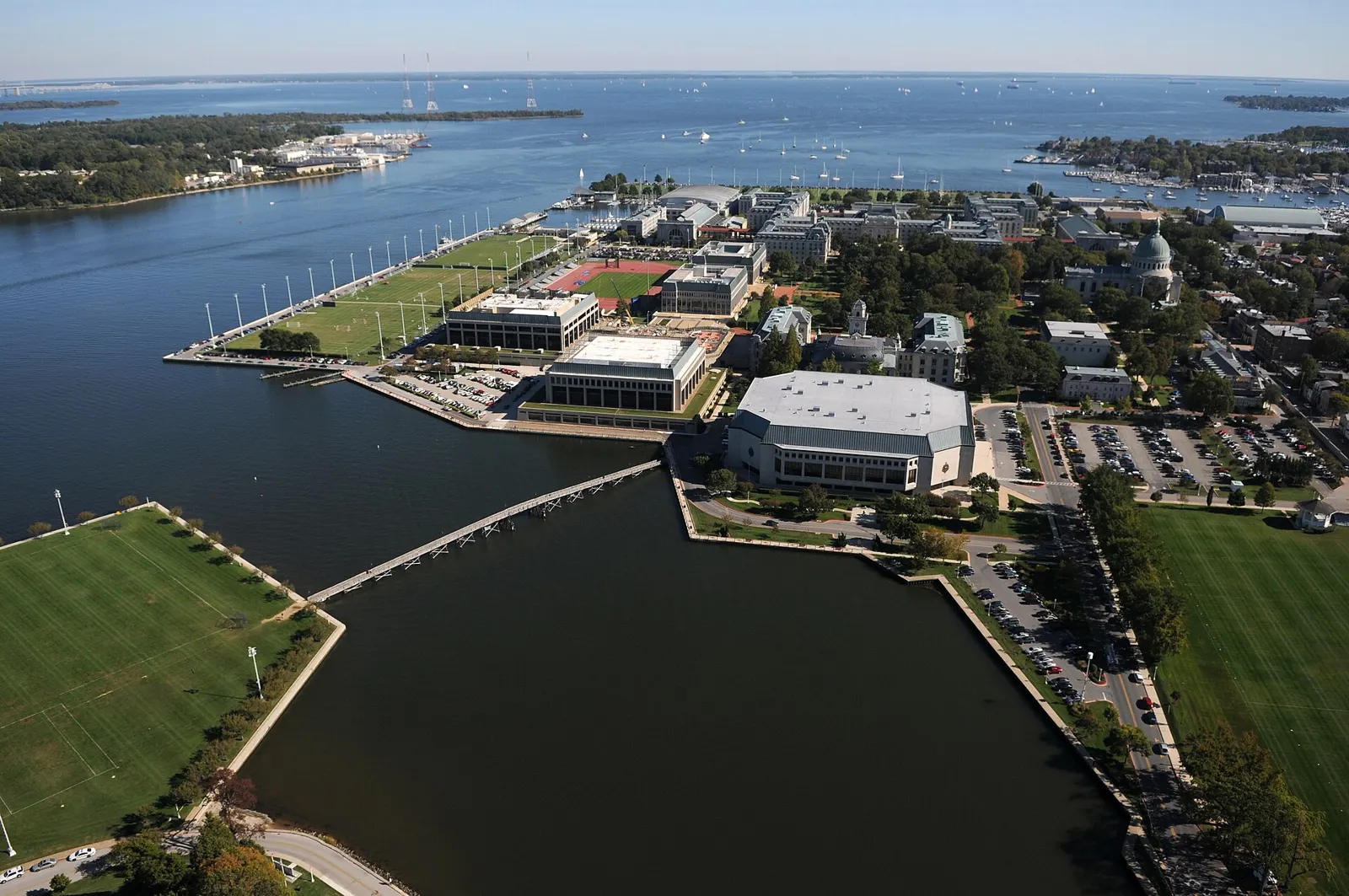
- 338 acres where the Severn River meets the Chesapeake Bay, beside Maryland's historic capital.
- Bancroft Hall
- One of the largest dormitories in the world, home to the entire brigade.
- Naval Academy Chapel
- Its dome rises over the Yard; the crypt beneath holds John Paul Jones.
- Herndon Monument
- The granite obelisk plebes climb to end their first year.
- Naval Academy Museum
- In Preble Hall, with collections of ship models, art and naval history.
- Navy-Marine Corps Memorial Stadium
- Opened in 1959 as a memorial to those who served in the Navy and Marine Corps.
West Point: The Hudson Highlands
- Setting
- A military reservation of more than 16,000 acres on bluffs above the Hudson River, about 50 miles north of New York City.
- The Plain and Trophy Point
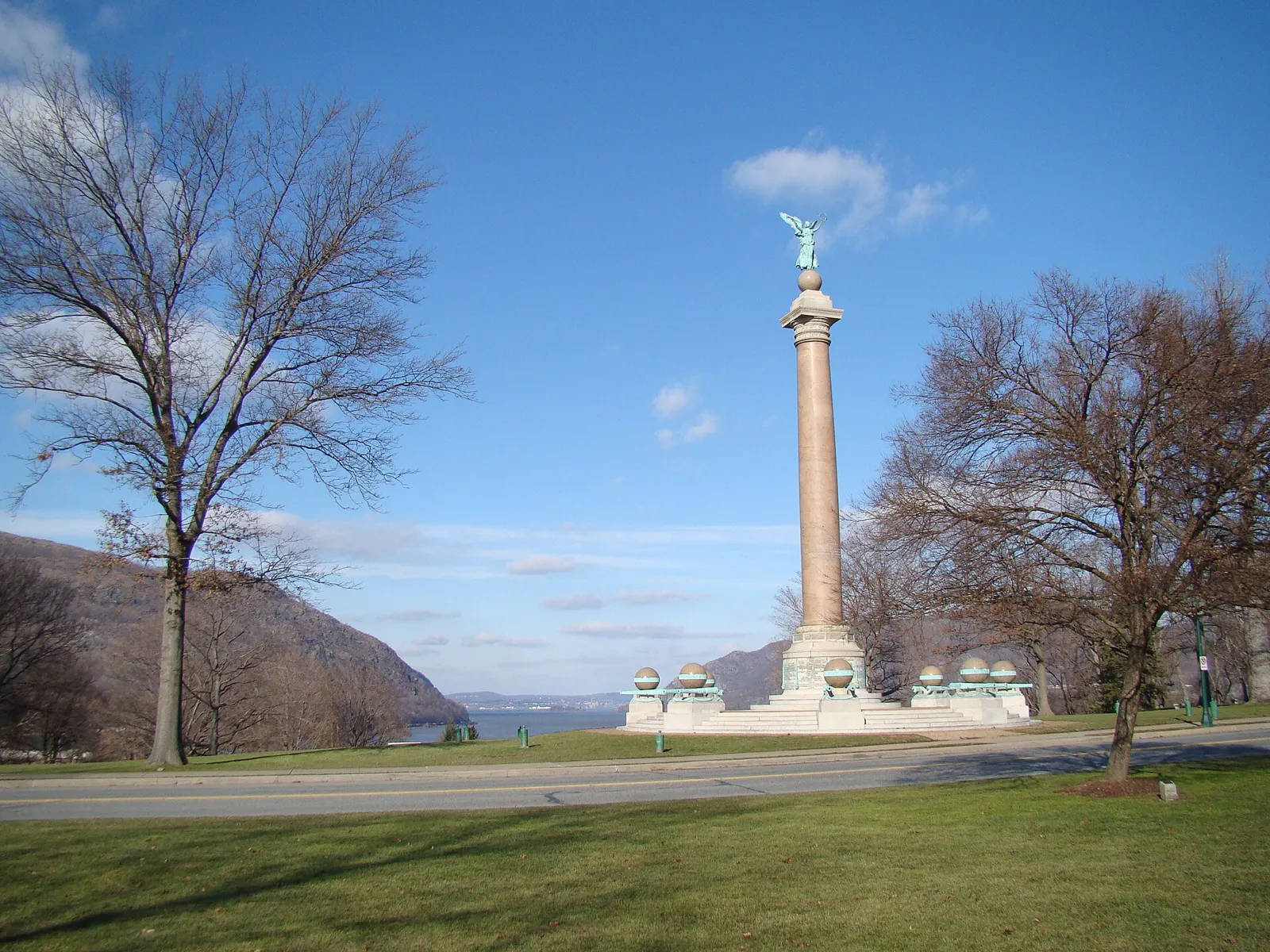
- The parade field at the heart of the academy, with the Battle Monument and links of the Great Chain overlooking the river.
- Cadet Chapel
- The Gothic Revival chapel on the hillside above the barracks.
- Fort Putnam
- A restored Revolutionary War fort built in 1778.
- Washington Hall and Thayer Hall
- The Corps' dining hall, and an academic building converted from the old riding hall and dedicated in 1956.
- West Point Cemetery and Michie Stadium
- A military cemetery designated in 1817, and the football stadium opened in 1924.
The settings feel very different. Annapolis is a tidewater town at sea level, and the Yard opens onto the water, with sailboats and yard patrol craft used for training just offshore; downtown shops and restaurants are a short walk from the gates. West Point sits in the rugged Hudson Highlands, with steep, wooded hills, granite buildings and long views up and down the river. It is more isolated, and its winters are typically colder and snowier than Annapolis'.
Photos of landmarks on both campuses, including the Herndon Monument, the Cadet Chapel and Trophy Point, appear in the Naval Academy landmarks and West Point landmarks sections.
Traditions: Navy vs. Army
Naval Academy traditions
- Herndon Monument climb
- Plebes form a human pyramid to replace a plebe cover with an upper-class hat atop the greased monument, marking the end of plebe year.
- Plebe Summer and Sea Trials
- The first and last tests of plebe year build teamwork through shared hardship.
- Noon meal formation
- The brigade forms in Tecumseh Court before lunch, a daily public display of military bearing.
- Bill the Goat
- Navy's mascot since 1893 and a frequent target of Army spirit missions.
- Navy Blue and Gold
- The alma mater, sung after games and at major ceremonies.
- Commissioning Week and the hat toss
- Graduates throw their midshipman covers into the air after taking the oath of office.
- Beat Army
- The rallying cry of the Army-Navy week spirit events across the Yard.
West Point traditions
- The Long Gray Line
- The continuous chain of graduates since 1802, invoked at every milestone.
- Duty, Honor, Country
- The motto, made famous by Douglas MacArthur's 1962 farewell address to the Corps.
- The Cadet Honor Code
- Its non-toleration clause makes every cadet responsible for the honor of the Corps.
- Beast Barracks
- Cadet Basic Training, ending with the March Back.
- The class ring and Ring Weekend
- West Point began the American class-ring tradition in 1835; seniors receive their rings in August of firstie year.
- 100th Night
- A banquet marking 100 days until graduation.
- Army mules
- Army's mascots since 1899.
- Beat Navy
- Painted, chanted and sung throughout Army-Navy week.
Both academies march on to the field before the Army-Navy Game, exchange a handful of cadets and midshipmen who spent a semester at the rival academy, and stand together for both alma maters after the final whistle — the winner's sung last. See Army-Navy traditions, the March On, the prisoner exchange, Sing Second and the rivalry pranks archive.
Famous graduates
Every person below graduated from the academy listed; well-known attendees who did not graduate are not included.
Naval Academy graduates
Class of 1901 · Navy
Ernest J. King
Highest rank: Fleet admiral
Served at the same time as chief of naval operations and commander in chief of the U.S. Fleet during World War II.
Class of 1904 · Navy
William F. Halsey Jr.
Highest rank: Fleet admiral
Commanded the Third Fleet in the Pacific during World War II.
Class of 1905 · Navy
Chester W. Nimitz
Highest rank: Fleet admiral
Commanded American naval forces in the Pacific during World War II. Nimitz Library is named for him.
Class of 1945 · Navy
Alan Shepard
Highest rank: Rear admiral
First American in space (1961) and later commander of Apollo 14, during which he walked on the moon. Graduated in 1944 with the Class of 1945.
Class of 1947 · Navy
Jimmy Carter
Highest rank: Lieutenant
Graduated in June 1946 under the wartime accelerated program and served in submarines, including work in the early nuclear-submarine program. The 39th president (1977-1981) and 2002 Nobel Peace Prize recipient is the only academy graduate to become president.
Class of 1947 · Navy
James Stockdale
Highest rank: Vice admiral
Senior naval officer among prisoners of war in North Vietnam, where he was held for more than seven years; received the Medal of Honor.
Class of 1949 · Navy
Wesley A. Brown
Highest rank: Lieutenant commander
The first Black graduate of the Naval Academy, 77 years after the first Black midshipman entered. He endured isolation and hostility, then served 20 years in the Navy Civil Engineer Corps. The academy's field house, dedicated in 2008, bears his name.
Class of 1952 · Navy
Jim Lovell
Highest rank: Captain
Flew on Gemini 7, Gemini 12, Apollo 8 and Apollo 13, whose crew returned safely after an in-flight explosion in 1970.
Class of 1961 · Navy
Joe Bellino
Halfback who won the 1960 Heisman Trophy, the first for a Navy player.
Football profileClass of 1965 · Navy
Roger Staubach
Won the 1963 Heisman Trophy, served four years on active duty including in Vietnam, then led the Dallas Cowboys to two Super Bowl victories.
Football profileClass of 1987 · Navy
David Robinson
Delayed his NBA debut to serve in the Navy, then won two NBA championships with the San Antonio Spurs and Olympic gold medals.
West Point graduates
Class of 1829 · Army; Confederate Army
Robert E. Lee
Superintendent from 1852 to 1855. Resigned his U.S. commission in 1861 and commanded Confederate forces, becoming general in chief of the Confederate armies. Later president of Washington College.
Class of 1840 · Army
William T. Sherman
Highest rank: General
Captured Atlanta and led the March to the Sea; succeeded Grant as commanding general of the Army.
Class of 1843 · Army
Ulysses S. Grant
Highest rank: General of the Army; posthumously General of the Armies
Led Union armies to victory in the Civil War and served as the 18th president (1869-1877). Approved in 2022 for posthumous promotion to general of the armies.
Class of 1877 · Army
Henry O. Flipper
First Black graduate; served with the 10th Cavalry and later worked as a civil and mining engineer.
Class of 1886 · Army
John J. Pershing
Highest rank: General of the Armies
Commanded the American Expeditionary Forces in World War I.
Class of 1903 · Army
Douglas MacArthur
Highest rank: General of the Army
Superintendent from 1919 to 1922, Army chief of staff, commander in the Pacific in World War II and commander of U.N. forces in Korea.
Class of 1909 · Army
George S. Patton Jr.
Highest rank: General
Competed in the 1912 Olympics and commanded the Seventh and Third armies in World War II.
Class of 1915 · Army
Dwight D. Eisenhower
Highest rank: General of the Army
Supreme commander of Allied forces in Europe in World War II, Army chief of staff and the 34th president (1953-1961). A halfback on the Army football team as a cadet.
Class of 1915 · Army
Omar N. Bradley
Highest rank: General of the Army
Commanded the 12th Army Group in Europe and became the first chairman of the Joint Chiefs of Staff.
Class of 1947 · Army; Air Force
Felix “Doc” Blanchard
“Mr. Inside,” winner of the 1945 Heisman Trophy and a member of three national championship teams.
Football profileClass of 1947 · Army
Glenn Davis
“Mr. Outside,” winner of the 1946 Heisman Trophy and a 10-letter athlete in four sports.
Football profileClass of 1951 · Air Force
Buzz Aldrin
Highest rank: Colonel
Lunar module pilot of Apollo 11 and the second person to walk on the moon.
Class of 1959 · Army
Pete Dawkins
Highest rank: Brigadier general
Won the 1958 Heisman Trophy while serving as class president and brigade commander; Rhodes Scholar.
Football profile
Football careers are covered in famous Army-Navy players, Heisman winners and NFL alumni.
Army vs. Navy football
Football started earlier at Annapolis. Navy played its first game on Dec. 11, 1879. Army's first game was the first Army-Navy Game, on Nov. 29, 1890, on the Plain at West Point; Navy won 24-0. The rivalry was suspended several times in its early decades but has been played every year since 1930, most often in Philadelphia, and it remains the last regular-season game of the major college football season.
Army's peak came in the 1940s, when coach Earl "Red" Blaik's teams won national championships in 1944, 1945 and 1946 behind Heisman winners Doc Blanchard and Glenn Davis. Navy claims a shared national championship (opens in a new tab) from its 9-0-1 season in 1926 and produced Heisman winners Joe Bellino in 1960 and Roger Staubach in 1963. Pete Dawkins added Army's third Heisman in 1958.
The series swings in long streaks. Navy won 14 straight from 2002 to 2015, the longest run by either team. Today both play in the American Athletic Conference, but Army-Navy remains a nonconference game. Combined with each academy's game against Air Force, it decides the Commander-in-Chief's Trophy (opens in a new tab).
Rivalry by the numbers
| Category | Naval Academy | West Point |
|---|---|---|
| Army-Navy wins (through 2025) | 64 | 55 |
| Ties | 7 | 7 |
| Current winning streak | 2 (since 2024) | — |
| Longest winning streak | 14 (2002-2015) | 5 (1927-1933) |
| Largest margin of victory | 51 points (51-0, 1973) | 38 points (38-0, 1949) |
| Heisman Trophy winners | 2 (Joe Bellino, 1960; Roger Staubach, 1963) | 3 (Doc Blanchard, 1945; Glenn Davis, 1946; Pete Dawkins, 1958) |
| Claimed national championships | 1 (1926, shared) | 3 (1944, 1945, 1946) |
| Commander-in-Chief's Trophy titles (outright, through 2025) | 18, including 2025 | 10 |
| Home stadium | Navy-Marine Corps Memorial Stadium (opened 1959) | Michie Stadium (opened 1924) |
| First football game | Dec. 11, 1879 | Nov. 29, 1890, against Navy |
Navy leads the all-time series 64-55-7 through the 2025 game. Series figures are calculated from every completed game in our results database. Air Force has won the trophy outright 21 times; the three academies shared it five times after three-way splits.
Explore the Complete Army-Navy Game History
Every result since 1890, records, streaks and the stories behind the rivalry.
Notable historical achievements
| Category | Naval Academy | West Point |
|---|---|---|
| Presidents | 1: Jimmy Carter | 2: Ulysses S. Grant and Dwight D. Eisenhower |
| Five-star officers of World War II | 4 fleet admirals: William D. Leahy, Ernest J. King, Chester W. Nimitz, William F. Halsey Jr. | 4: Douglas MacArthur, Dwight D. Eisenhower, Henry H. Arnold, Omar N. Bradley |
| Medal of Honor recipients among graduates | 73 (academy count, 2026) | 77 (academy count, 2026) |
| Astronauts | 56 graduates selected as astronauts (academy count, 2026) | 21 graduates selected by NASA (as of May 2021) |
| Science | Albert A. Michelson, Class of 1873, the first American Nobel laureate in science (physics, 1907) | The nation's first engineering school; graduates surveyed and built much of 19th-century America's infrastructure |
| Engineering milestones | Graduates led the Navy's nuclear propulsion program under Adm. Hyman G. Rickover, Class of 1922 | George W. Goethals, Class of 1880, directed construction of the Panama Canal |
| Space firsts | Alan Shepard, Class of 1945, the first American in space (1961) | Buzz Aldrin, Class of 1951, the second person to walk on the moon (1969) |
| Integration | First Black graduate: Wesley A. Brown, 1949. First women admitted 1976, graduated 1980 | First Black graduate: Henry O. Flipper, 1877. First women admitted 1976, graduated 1980 |
Both academies' histories include serious injustices. Black cadets and midshipmen in the 19th and early 20th centuries were isolated, hazed and often driven out — Flipper was the first of several Black cadets admitted after the Civil War to graduate from West Point, and no Black midshipman graduated from Annapolis until 1949. Women were barred until Congress opened the academies in 1975, and the first women faced open hostility. Counts of Medal of Honor recipients and astronauts are each academy's own and use different cutoff dates, so they are not exact head-to-head comparisons.
Which academy should you choose?
Neither academy is universally better. Use this Academy Comparison Guide to see which one lines up with your interests, then talk with admissions officers, current students and graduates of both.
| If this matters to you | Naval Academy | West Point |
|---|---|---|
| Desired service | Navy or Marine Corps | Army |
| Where you would serve | At sea, in the air, with Marine units ashore | With Army units on land, in the air and in cyberspace |
| Academic interests | Naval architecture, ocean engineering, oceanography, nuclear and aerospace engineering | Civil, chemical and environmental engineering, law, psychology, philosophy, foreign languages |
| Training environment | Sailing, seamanship, fleet cruises and Marine field training | Field exercises, Army schools such as Air Assault, and service with Army units |
| Campus setting | Waterfront town on the Chesapeake Bay, close to Washington and Baltimore | Wooded highlands above the Hudson, more remote, colder winters |
| Physical demands | Rigorous at both: Plebe Summer, Sea Trials and a test every semester | Rigorous at both: Beast Barracks, field training and the Army Fitness Test |
| Leadership opportunities | Run the Brigade of Midshipmen; lead sailors or Marines after graduation | Run the Corps of Cadets; lead an Army platoon after graduation |
| Athletics | Every midshipman plays varsity, club or intramural sports | Every cadet competes in a sport each semester |
| Service commitment | At least five years active; longer for aviation | Five years active and three reserve; longer for aviation |
Compare by topic
Choose an area of interest to see the relevant facts side by side. This tool shows published facts only; it does not estimate admission chances or predict assignments.
| Category | Naval Academy | West Point |
|---|---|---|
| Degree | Bachelor of Science | Bachelor of Science |
| Academic majors | 23 for current classes (2025-26) | 36 (academy figure) |
| Student-faculty ratio | 8 to 1 (2025-26) | 7 to 1 (academy figure) |
| Cybersecurity | Cyber Operations | Cyber Science |
| Naval architecture | Naval Architecture and Marine Engineering | No equivalent |
| Civil and environmental engineering | No equivalent | Civil Engineering; Environmental Engineering |
| Foreign languages | Minors only (Arabic and Chinese majors end with the Class of 2027) | Majors in Arabic, Chinese, French, German, Persian, Portuguese, Russian and Spanish |
Frequently asked questions
Is West Point better than the Naval Academy?
Neither is better in general; the comparison is subjective. Both are highly selective, tuition-free and nationally respected. The right choice depends on whether you want to serve in the Army or in the Navy or Marine Corps, and on which majors, training and setting fit you best.
Which academy is older?
West Point. It was established on March 16, 1802, 43 years before the Naval Academy opened on Oct. 10, 1845.
Which academy is harder to get into?
There is no reliable answer. The Naval Academy's Class of 2030 offers divided by applications works out to 8.7%, but West Point did not publish a comparable offer count, and the academies count applicants differently. Both require a nomination, medical qualification and fitness test, and both are among the most selective colleges in the country.
What is the biggest difference between West Point and Annapolis?
The service each feeds. West Point commissions Army officers; Annapolis commissions Navy and Marine Corps officers. That difference shapes their majors, summer training, campus and career options.
Can Naval Academy graduates become Marines?
Yes. About a quarter do — 267 of the Class of 2026's assignments were to the Marine Corps, after candidates completed the Leatherneck summer program at Quantico.
Can West Point graduates join the Navy?
Rarely. West Point graduates are commissioned in the Army. A small number from each academy are approved each year to commission into another service, but that is an exception, not a path to plan on.
Is tuition free at both academies?
Yes. Neither charges tuition, room or board. Graduates repay the education with military service.
Do cadets and midshipmen get paid?
Yes. Federal law sets their pay at 35% of a new officer's basic pay — $1,452.90 a month in 2026 before deductions for uniforms, books, a computer and other required costs.
What are the service obligations?
West Point graduates owe five years of active duty and three in the reserves. Naval Academy graduates owe at least five years of active duty. Pilots owe more: eight years after flight training in the Navy and Marine Corps, 10 years in the Army.
Which academy has more students?
They are about the same size, with roughly 4,400 midshipmen and roughly 4,400 cadets.
Which has more academic majors?
West Point, with 36 majors by its count, compared with 23 for current Naval Academy classes. The count reflects different structures — West Point lists separate language and regional majors — and Annapolis offers some technical majors West Point does not, such as naval architecture.
Which academy produces more generals or admirals?
The academies do not publish comparable totals, so there is no verified answer. Each produced four of the nine five-star officers of World War II.
Which academy has produced more presidents?
West Point, with two: Ulysses S. Grant and Dwight D. Eisenhower. Jimmy Carter is the Naval Academy's only presidential graduate.
Which academy has produced more astronauts?
The Naval Academy reports 56 graduates selected as astronauts; West Point reported 21 NASA selections as of May 2021. The counts use different dates and definitions.
Which academy has won more Army-Navy football games?
Navy. Navy leads the all-time series 64-55-7 through the 2025 game. Navy won the first meeting, 24-0, in 1890.
Which academy has more football national championships?
Army, with three claimed titles (1944, 1945 and 1946). Navy claims one, a shared title from 1926.
Are women admitted to both academies?
Yes. Both admitted their first women in 1976 and graduated them in 1980.
Can applicants apply to both academies?
Yes. Many candidates apply to more than one service academy, and members of Congress can nominate a candidate to more than one. A candidate can accept only one appointment.
What are the medical and physical requirements?
Both require a medical exam reviewed by the Department of Defense Medical Examination Review Board and a six-event Candidate Fitness Assessment that includes a basketball throw, pull-ups or flexed-arm hang, shuttle run, abdominal exercise, push-ups and a one-mile run.
How do congressional nominations work?
Each U.S. representative and senator may nominate candidates for vacancies at each academy, usually after an application and interview in the fall of senior year. Deadlines vary by office, so candidates should contact their members of Congress early. Other categories, such as presidential and service-connected nominations, exist for military families and enlisted service members.